

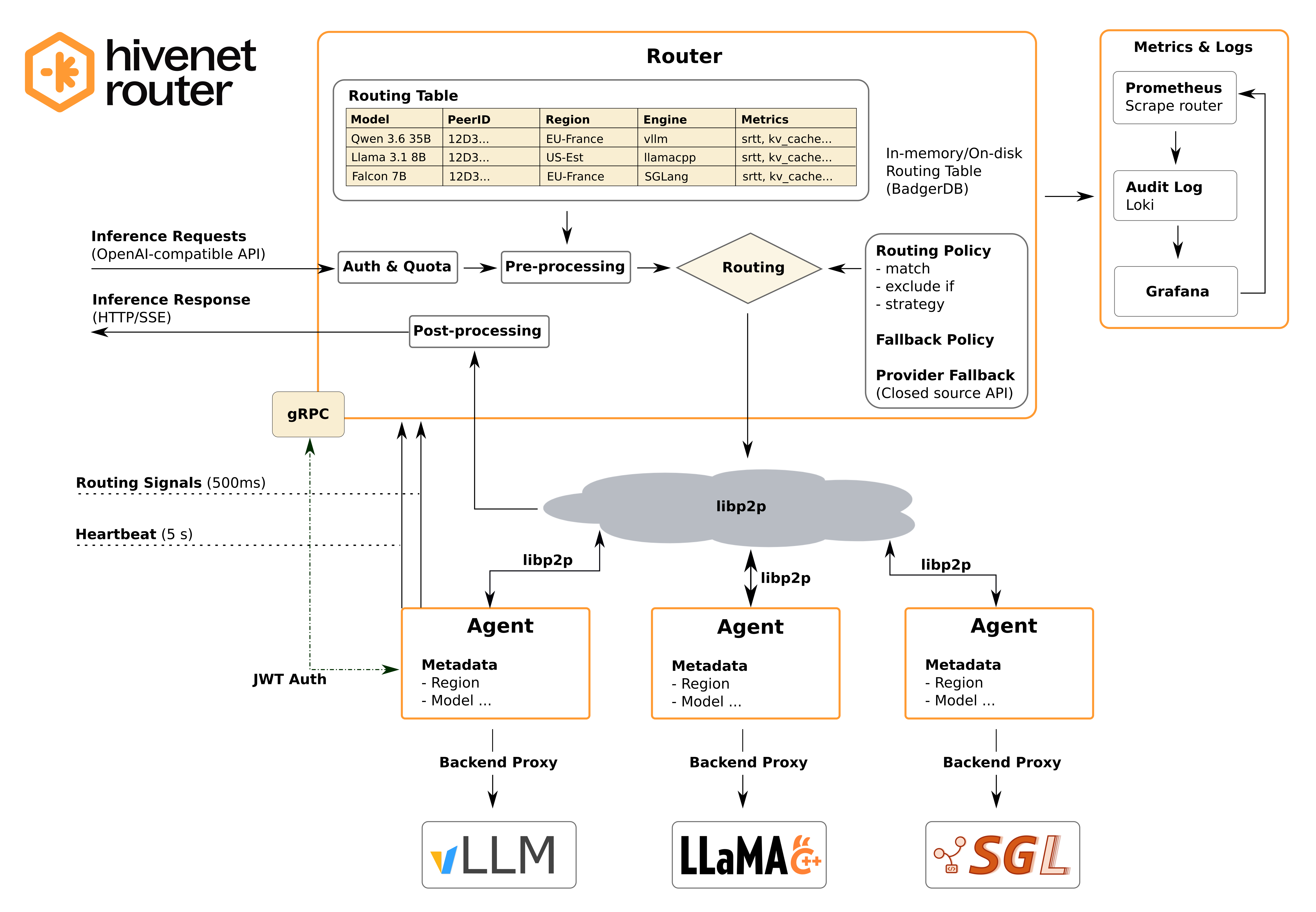
Main components
Hivenet Router has two runtime components: the router and one or more agents.Router
The router is the central entry point and coordinator. It:- exposes OpenAI-compatible and Anthropic-compatible inference endpoints
- authenticates clients when API authentication is enabled
- authenticates and registers agents
- tracks agent health, models, capabilities, and metadata
- evaluates routing policies
- selects an available agent for each request
- enforces quotas and model restrictions
- maintains operational and historical state
- exports Prometheus metrics
The router’s libp2p interface listens on
127.0.0.1 by default. For agents on other machines, configure --p2p-listen-addr with an address they can reach.Agent
An agent connects one inference backend to the router. It:- authenticates with the router
- registers its engine, model, capability, capacity, region, and tags
- forwards inference requests to its local backend
- checks backend health
- collects CPU, memory, and GPU metrics
- scrapes engine metrics when the backend exposes them
- sends heartbeats and routing signals to the router
- maintains a persistent libp2p identity when an identity path is configured
llmembeddingreranker
Supported backends
A deployment can mix different backend types. Applications continue to use the router’s API rather than connecting to each backend separately.
Request lifecycle
A typical inference request moves through Hivenet Router like this:1
Client sends a request
A client sends a request to the router.
2
Client authentication
The router authenticates the client if API authentication is enabled.
3
Model and capability
The router identifies the requested model and capability.
4
Static matching
Static policy filters remove agents that do not match the request.
5
Dynamic gates
Dynamic policy gates remove agents that fail configured health or metric thresholds.
6
Ranking
The routing strategy ranks the remaining agents.
7
Capacity acquisition
The router acquires capacity on the selected agent.
8
Forward to agent
The request is forwarded to the agent over the encrypted libp2p data plane.
9
Backend execution
The agent sends the request to its local inference backend.
10
Response
The response returns through the agent and router to the client.
11
Record outcome
Hivenet Router records the outcome and updates routing and latency metrics.
Routing pipeline
Routing policies use three stages.least-loaded is currently the only implemented ranking strategy. It ranks agents by the proportion of their declared capacity that is in use.
If you do not configure a policy file, Hivenet Router uses its built-in least-loaded policy without static filters or dynamic gates.
Control and data paths
Hivenet Router separates authentication from inference traffic.Agent authentication
1
Sign JWT
The agent signs a JWT with the shared secret.
2
Connect to gRPC
It connects to the router’s gRPC authentication endpoint.
3
Validate token
The router validates the token and agent metadata.
4
Return session
The router returns a session token and its libp2p address.
5
Register over libp2p
The agent registers over libp2p using the session token.
Request forwarding
Router-agent traffic uses libp2p with Noise encryption. The same connection carries registration, heartbeats, routing signals, and forwarded inference requests. Agents initiate the persistent connection to the router, which then uses that established connection for bidirectional signaling and request forwarding.Client traffic
The router’s built-in API server listens over HTTP.For production deployments, place the API behind a reverse proxy or load balancer that provides TLS and any network controls your environment requires.
Health and metrics
Agents collect backend and system state at different intervals. The router uses these signals to maintain agent health and make routing decisions.
Routing signals carry recent engine and hardware data without updating the agent’s heartbeat timestamp. Heartbeats act as the health keepalive and include fallback metric information.
This separation lets Hivenet Router receive fresh routing data without treating every metrics update as proof that the agent is healthy.
Storage
Hivenet Router uses two BadgerDB stores.
The in-memory database is rebuilt as agents connect and report state.
The disk database preserves information such as smoothed round-trip time and lifetime counters across router restarts. You can change its path and retention period through router configuration.
Persistent daily token-quota counters use separate day-based records with a 48-hour lifetime. This provides an overlap between quota periods while preventing old counters from accumulating indefinitely.
Authentication and access control
Hivenet Router handles agent and client authentication separately.Agents
Agents authenticate with a shared HMAC-SHA256 secret. The router validates their JWTs over the gRPC authentication connection.API clients
The inference API supports three authentication modes:
API keys can also define:
- allowed models
- requests-per-minute limits
- daily token limits
- ownership and descriptive metadata
- expiration dates
Deployment shape
The router and agents do not need to run in the same place. Common deployments include:- one router and several agents on a private network
- agents distributed across multiple sites
- inference backends running on bare-metal GPU hosts
- router and agents running in Docker
- a mix of local infrastructure and hosted compute instances
What to read next
Quickstart
Deploy a router and several agents, then send your first routed request.
Hivenet Router and Hivenet services
Understand how Hivenet Router differs from Hivenet Inference API and Compute with Hivenet.